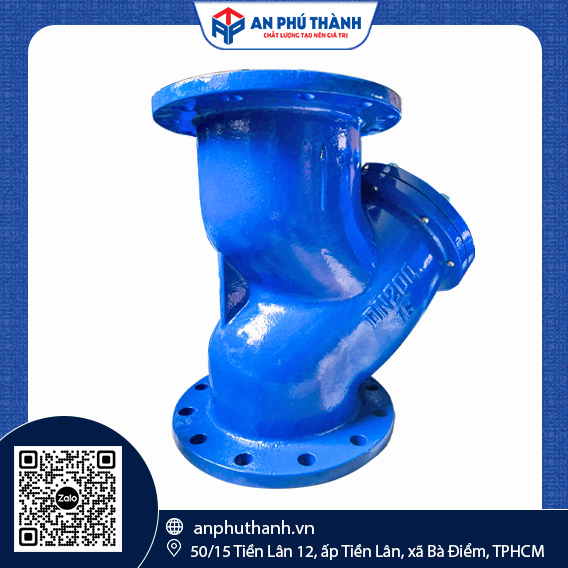
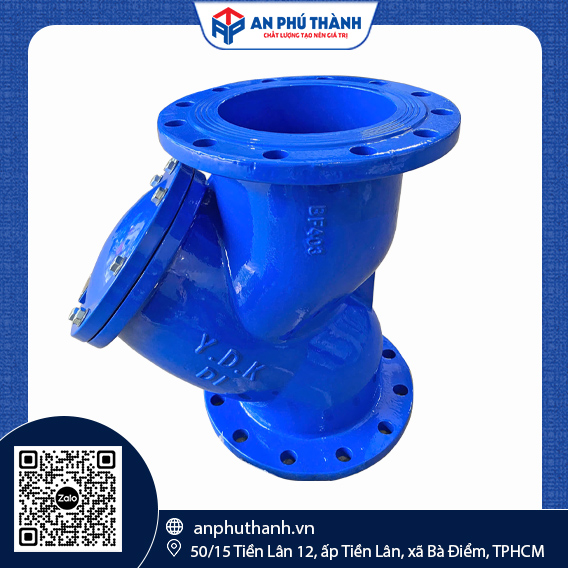
YDK Flanged Y-Strainer | Model: KGL-16
| Brand | Y.D.K |
| Model | KGL-16 |
| Pressure Standard | PN16 |
A Y strainer is a device used to filter dirt, debris, and solid particles from pipelines before the fluid reaches sensitive downstream equipment such as pumps, control valves, or pressure gauges. The name comes from the Y-shaped body of the device. One branch allows the fluid to flow straight through, while the other branch contains an inclined filter screen that captures dirt and debris without significantly restricting the flow through the valve.
Physically, a Y strainer is one of the simplest types of pipeline equipment. It consists of only a few main components:
| Component | Function |
| Valve Body | Directs the flow in a Y-shaped configuration and withstands system pressure |
| Filter Screen | Captures dirt and solid particles in the fluid |
| Drain Cap (Cleaning Cap) | Can be removed to clean the filter screen or drain accumulated debris periodically without dismantling the entire pipeline section |
| Sealing Gasket | Prevents leakage at the contact point between the drain cap and valve body |
| Connection | Connects the strainer to the pipeline using threaded, flanged, or welded connections depending on the system size |
In terms of materials, Y strainers are commonly available in the following types:
A Y strainer can be installed on both horizontal and vertical pipelines.
A Y strainer usually has a raised arrow on its body indicating the flow direction. The strainer must be installed so that the arrow matches the actual direction of fluid flow. Never install it in the opposite direction, as this can prevent the filter screen from properly capturing debris. It may even cause the screen to become dislodged due to flow pressure acting in the wrong direction.
To facilitate periodic cleaning, sufficient clearance should be left below or beside the Y strainer installation position. If the device is installed too close to a wall or another piece of equipment, making it impossible to remove the drain cap, the entire pipeline section may need to be dismantled each time the strainer is cleaned, resulting in unnecessary additional work.
The actual type of contaminants in the system should be determined in advance to select the appropriate filter screen mesh size. If the openings are too small for the application, the screen will clog quickly and require frequent cleaning. If the openings are too large, fine particles will not be filtered effectively, reducing the protection provided to downstream equipment.
For critical systems, it is recommended to install pressure gauges before and after the Y strainer to monitor the pressure differential. When the pressure differential gradually increases over time, it indicates that the filter screen is becoming clogged and needs to be cleaned, rather than waiting until a noticeable reduction in flow occurs before detecting the problem.
This is one of the key differences between Y strainers and many other types of valves. The filter screen should be cleaned periodically, typically every 2 to 6 months, depending on the level of dirt and debris in the fluid source. If cleaning is neglected, a clogged filter screen will reduce flow pressure and negatively affect the operating efficiency of the entire system.
An Phú Thành specializes in supplying Y strainers in a wide range of materials and sizes from DN15 to DN600, suitable for both residential and industrial systems. All products have clear origins, complete CO/CQ documentation, and transparent warranty policies.
Customers can refer to An Phú Thành's available Y strainer models below, with complete information on material, filter screen mesh size, and connection type for each model.
If you need advice on selecting a Y strainer suitable for your actual water source or fluid, please contact us via Hotline or Zalo at 0946 729 913 for prompt assistance. An Phú Thành's experienced team is always pleased to serve you.
Do you need product advice or a quote? Leave your details, and the technical team at An Phu Thanh will contact you within 24 hours.