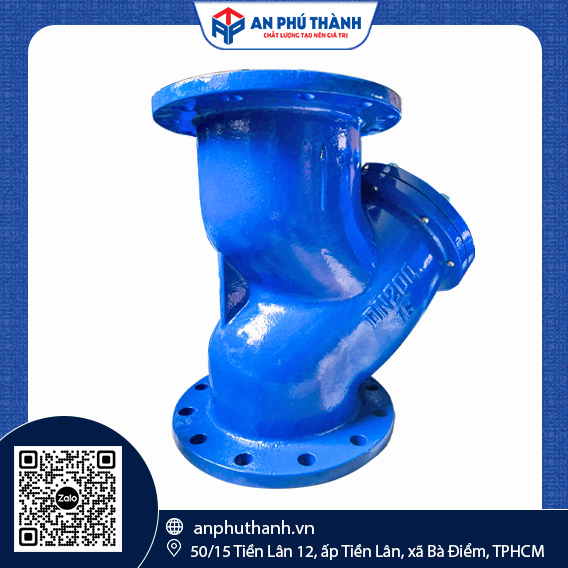


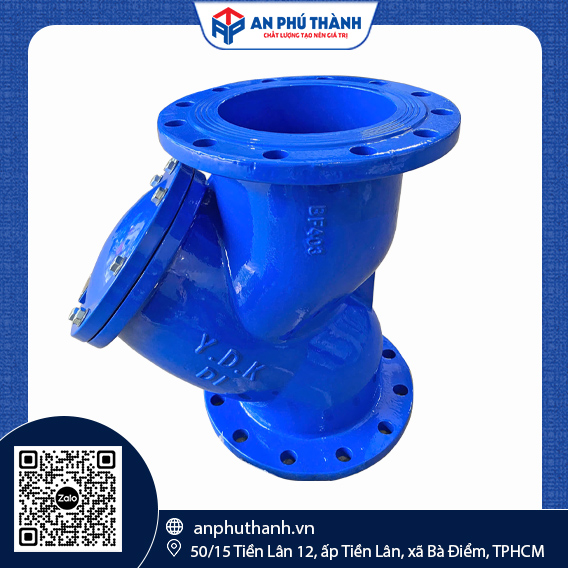
YDK Flanged Y-Strainer | Model: KGL-16
| Brand | Y.D.K |
| Model | KGL-16 |
| Pressure Standard | PN16 |
| Brand | BTL |
| Origin | China |
| Nominal pressure | PN16 |
| Flange standard | BS4504 |
| Shell test | 2.4MPa |
| Seal test | 1.76 MPa |
| Maximum working temperature | 80°C |
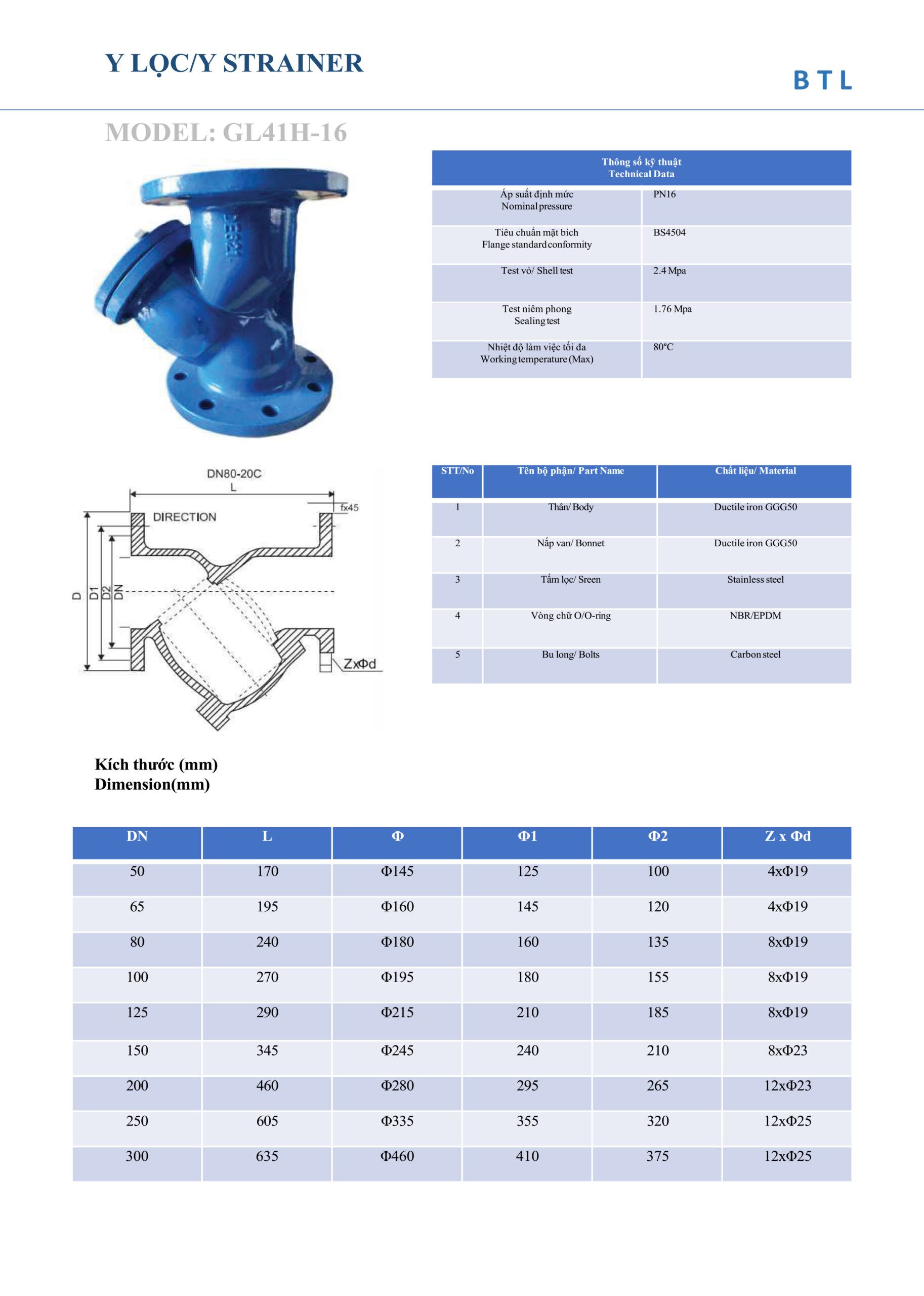
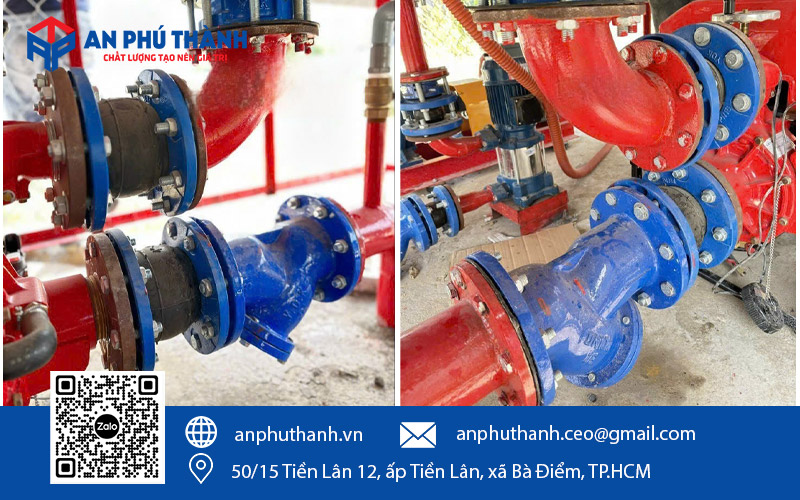
The BTL Y-strainer, Model GL41H-16, is an important pipeline protection device that acts as a “shield”, removing dirt, gravel, rust, and other mechanical impurities from the fluid stream. Installing a Y-strainer directly upstream of measuring devices such as water meters, pressure reducing valves, check valves, or pumps helps prevent jammed impellers, scratched valve discs, and system damage. This keeps the entire pipeline running smoothly and safely for operators.
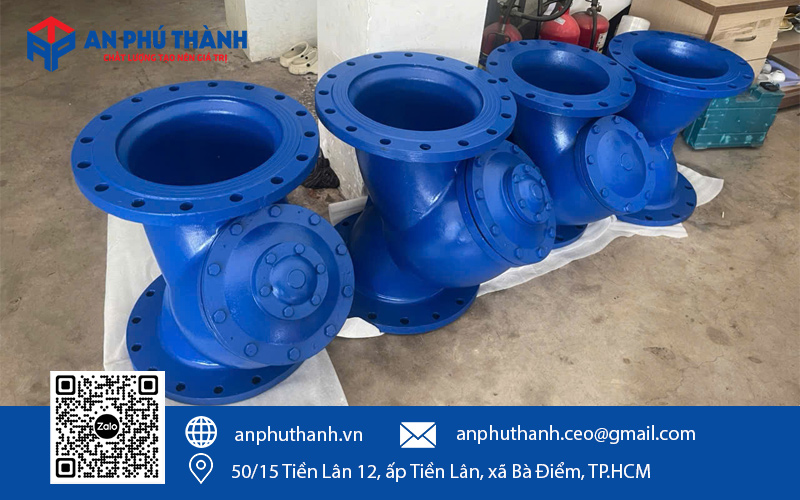
Like the other Y-strainers supplied by An Phu Thanh, this product has a body inclined at 45 degrees, flange connections to the BS4504 standard, and a construction of 5 main parts.
| No. | Component | Material | Function |
|---|---|---|---|
| 1 | Body | Ductile iron GGG50 | Y-shaped valve body with flanges at both ends for connection to the pipeline. The body contains the sediment collection chamber below and the chamber that holds the strainer screen |
| 2 | Cover | Ductile iron GGG50 | Seals the strainer chamber and can be removed to pull out the strainer screen for cleaning |
| 3 | Strainer screen | Stainless steel | Cylindrical perforated or woven-mesh screen that retains dirt, rust, and debris in the flow before the fluid passes to the equipment downstream |
| 4 | O-ring | NBR/EPDM | Seals between the cover and the valve body, preventing leakage at the assembly point |
| 5 | Bolts | Carbon steel | Tighten the cover to the body and secure the entire cover and strainer assembly |
The inclined design of the BTL Y-strainer gives lower pressure loss than a T-type strainer. The Y-strainer can also be installed both horizontally and vertically (on a pipeline with downward flow), making it easy to fit a wide variety of pipeline layouts.
| DN | L (Length – mm) | Φ (Outside diameter – mm) | Φ1 (Bolt circle diameter – mm) | Φ2 (Raised face diameter – mm) | Z x Φd (No. of holes × hole diameter) |
|---|---|---|---|---|---|
| 50 | 170 | 145 | 125 | 100 | 4 x Φ19 |
| 65 | 195 | 160 | 145 | 120 | 4 x Φ19 |
| 80 | 240 | 180 | 160 | 135 | 8 x Φ19 |
| 100 | 270 | 195 | 180 | 155 | 8 x Φ19 |
| 125 | 290 | 215 | 210 | 185 | 8 x Φ19 |
| 150 | 345 | 245 | 240 | 210 | 8 x Φ23 |
| 200 | 460 | 280 | 295 | 265 | 12 x Φ23 |
| 250 | 605 | 335 | 355 | 320 | 12 x Φ25 |
| 300 | 635 | 460 | 410 | 375 | 12 x Φ25 |
The Y-strainer is usually installed on main pipelines, upstream of equipment that needs protection from dirt and debris, at locations such as:
For orientation, the body of the Y-strainer carries an arrow (DIRECTION) showing the flow direction. Technicians must install it in the direction of the arrow so that the fluid enters from above and passes through the strainer screen before leaving the Y-strainer. In particular, do not install it in the reverse direction, as this will defeat the purpose of the Y-strainer.
The strainer branch should be installed pointing downward or horizontal, depending on the flow direction of the system, so that the sediment chamber sits at the lowest position, allowing heavy debris and rust to accumulate and be drained out easily during cleaning. At the same time, make sure there is enough clearance below the inclined branch to remove and refit the cover and pull out the strainer screen during maintenance.
An Phu Thanh specializes in distributing the genuine BTL Y-strainer GL41H-16 in the full size range from DN50 to DN300, with CO and CQ certificates. If you need technical consultation or a project discount quotation, please contact Hotline/Zalo OA: 0946 729 913. The experienced team at An Phu Thanh will respond to you as soon as possible!
Do you need product advice or a quote? Leave your details, and the technical team at An Phu Thanh will contact you within 24 hours.