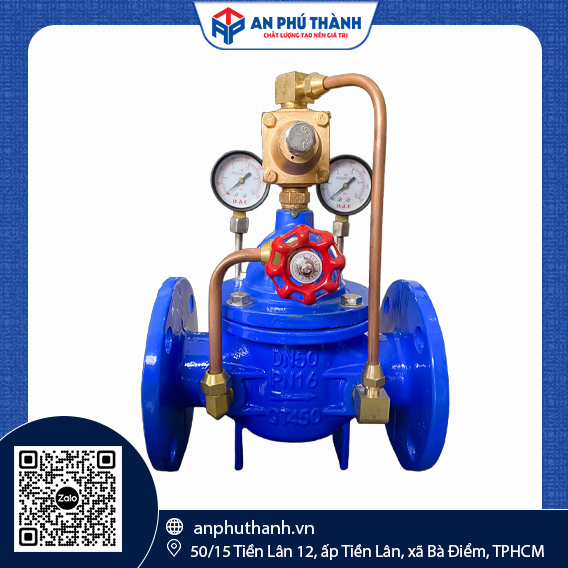
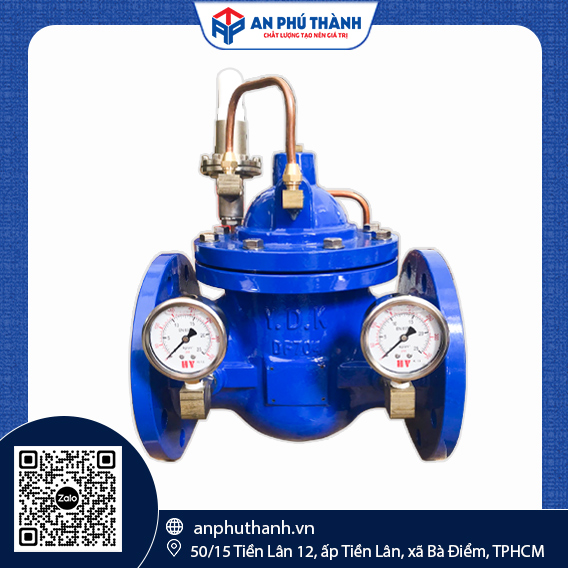
YDK Pressure Reducing Valve - Model: KCV200
| Brand | Y.D.K |
| Model | KCV200 |
| Pressure Standard | PN10, PN16 |
A Pressure Reducing Valve (PRV) is an industrial valve designed to regulate and maintain a stable downstream pressure at a preset level, regardless of fluctuations in inlet pressure. Unlike a safety valve, which only opens in the event of overpressure, a pressure reducing valve operates continuously throughout system operation to protect downstream equipment from pressure exceeding allowable limits.
PRVs are commonly used in domestic water supply systems, industrial steam systems, compressed air systems, and pipelines where the inlet pressure is significantly higher than the pressure that downstream equipment can withstand.
| Component | Function |
| Valve Body | Contains the internal components, provides the flow passage, and withstands system pressure |
| Diaphragm or Piston | Senses the downstream pressure and transmits the control force to the valve disc |
| Valve Disc | Adjusts the opening to regulate flow and maintain stable downstream pressure |
| Spring or Control Pilot | Creates a balancing force against the downstream pressure and determines the preset pressure level |
| Pilot Valve (indirect-acting type only) | A small auxiliary valve that senses downstream pressure and controls the main valve diaphragm chamber through a separate sensing line |
| Adjustment Screw | Allows the desired downstream pressure level to be adjusted |
| Sealing Gasket | Prevents leakage at contact points |
| Connection | Connects the valve to the pipeline, using threaded or flanged connections depending on the system size |
When the downstream pressure is lower than the preset level, the spring force (or pilot control) pushes the valve disc further open, increasing the flow rate through the valve and raising the downstream pressure to the desired level. When the downstream pressure rises above the preset level, the pressure acts against the diaphragm or piston, causing the valve disc to close partially and reduce the flow rate until the downstream pressure returns to the preset level.
With a pilot-operated type, this process takes place through a continuous sensing loop between the pilot valve and the main valve, allowing faster and more precise response even when the inlet pressure changes suddenly.
Note: The pressure reducing valve must be installed in the correct flow direction according to the arrow marked on the valve body. When using a direct-acting pressure reducing valve, it is recommended to install pressure gauges at both the inlet and outlet for easier monitoring and adjustment. For indirect-acting valves, a Y-strainer should be installed on the pilot sensing line to prevent debris from accumulating and causing the pilot valve to become stuck. Isolation valves should also be installed on both sides of the pressure reducing valve to facilitate maintenance without having to shut down the entire pipeline.
There are currently two main types of pressure reducing valves on the market: direct-acting pressure reducing valves and indirect-acting pressure reducing valves.
| Type | Mechanism | Application Scale |
| Direct-Acting Valve | Downstream pressure acts directly on the diaphragm or piston, working together with the spring force to control the valve disc | Low- and medium-pressure systems that do not require high precision |
| Indirect-Acting Valve (Pilot-Operated) | A small pilot valve senses downstream pressure and controls the main valve through the diaphragm chamber | Large systems requiring high precision and stability when inlet pressure fluctuates significantly |
An Phu Thanh supplies both types of pressure reducing valves, meeting the requirements of projects ranging from small-scale civil works to large systems requiring high precision. For projects with existing M&E drawings, our technical team can directly compare the design specifications with the product specifications to select the appropriate valve type.
If you are unsure which type of pressure reducing valve is suitable for your project, please contact An Phu Thanh via Hotline or Zalo OA: 0946 729 913. Our team will advise you on the appropriate valve type based on your actual system requirements.
You can refer to the list of pressure reducing valves currently available from An Phu Thanh below. Complete information, including size, working pressure range, and design drawings, is provided for each product model.
Do you need product advice or a quote? Leave your details, and the technical team at An Phu Thanh will contact you within 24 hours.